

Content Supply Chain Automation: An Enterprise Guide from Intake to Measurable Release
Eight connected control points turn a content request into compliant, effective work that can be reused, localized, released, and measured. When those controls live in separate inboxes, spreadsheets, CMS queues, DAM folders, and approval tools, tighter deadlines create more status chasing and more risk. Content supply chain automation connects the work, evidence, decisions, and systems required to move from intake to verified outcome.
Content supply chain automation is the use of governed workflows, shared context, connected systems, and bounded agentic execution to coordinate content intake, reuse, asset operations, localization, approvals, release, governance, and measurement. It does not mean removing human judgment. It means giving every person and agent the approved inputs, permissions, evidence, and exit criteria needed to advance work safely.
This guide owns the implementation playbook. For the category definition and maturity model, read AI Content Operations. For structured page assembly, read the CMS Authoring Guide.
What is content supply chain automation?
Content supply chain automation coordinates the complete enterprise content lifecycle, from a validated request through creation, reuse, asset management, localization, review, release, and performance learning. The workflow carries context and evidence between systems so teams do not rebuild the brief or re-prove readiness at every handoff.
| Control point | Automation job | Human responsibility |
|---|---|---|
| 1. Intake | Classify the request, sources, scope, risk, owner, and due date | Confirm priority and definition of done |
| 2. Reuse | Find approved modules, claims, assets, and prior decisions | Choose what remains fit for the audience and moment |
| 3. DAM | Resolve asset identity, rights, metadata, renditions, and references | Approve creative suitability and restricted use |
| 4. Localization | Create governed variants with terminology and market context | Decide cultural, legal, and market exceptions |
| 5. Approval | Route the right evidence to the right reviewer | Accept, reject, or request a specific change |
| 6. Release | Advance only approved scope through environment controls | Authorize consequential live actions |
| 7. Governance | Apply policy, permissions, provenance, budgets, and stop conditions | Own risk policy and exception decisions |
| 8. Measurement | Connect workflow, quality, cost, and audience signals | Change priorities and operating rules based on evidence |
Why enterprise content supply chains break under pressure
Deadlines expose coordination debt. The work may be creative, but the delay often sits in missing inputs, unclear ownership, repeated asset searches, late compliance questions, locale rework, and release uncertainty.
- Incomplete intake: Work begins before the source, audience, owner, destination, risk, or acceptance criteria are clear.
- Reuse without lineage: Teams copy approved content but lose the source, usage limits, review history, or update relationship.
- DAM friction: The correct file exists, but rights, rendition, metadata, or destination fit remain uncertain.
- Localization debt: Markets receive late, unstable source content and must reconstruct context while the launch date stays fixed.
- Approval queues: Reviewers receive full documents instead of the exact change, evidence, risk, and decision required.
- Release ambiguity: A completed draft is confused with an approved, staged, published, and verified experience.
- Activity reporting: Teams count drafts and tasks rather than approved outcomes, rework, quality, cost, and audience impact.
A practical operating model for the content supply chain
Design the supply chain around one unit of work, such as an approved page, asset package, localized experience, campaign update, or regulated content change. Every step should preserve six things: request, context, action, evidence, decision, and outcome.
- Request: What must change, for whom, by when, and why?
- Context: Which approved facts, brand rules, designs, assets, terminology, policies, and prior decisions apply?
- Action: Which person or agent can perform which bounded change in which system?
- Evidence: What source, comparison, check, preview, or audit record proves readiness?
- Decision: Who can approve the work, accept an exception, or authorize release?
- Outcome: What visible customer result and measurable business or operating signal confirms completion?
This shared contract lets specialized tools and teams work independently without losing the thread of accountability.
1. Automate intake without automating bad requests
Intake automation should improve request quality before it accelerates production. A request can arrive through a ticket, form, brief, design, spreadsheet, or conversation. The workflow extracts the required fields, checks source availability, classifies risk, identifies likely dependencies, and routes missing decisions back to the requester.
- Trigger: A new request, approved plan, product change, search signal, legal update, or recurring calendar event enters the queue.
- Route: Content type, destination, locale, risk, and deadline determine the owner and workflow path.
- Evidence: Approved sources, designs, assets, target routes, and acceptance criteria travel with the request.
- Exit: Production starts only when scope, owner, inputs, protected areas, and definition of done are complete.
See the detailed Content Intake and Orchestration guide.
2. Build reuse around approved modules and lineage
Reuse is not copying. It is the controlled application of an approved content module, claim, asset, or pattern in a new context while preserving ownership, provenance, dependencies, and update rules.
- Find: Search by audience, product, intent, market, status, taxonomy, and rights.
- Evaluate: Confirm factual freshness, brand fit, legal scope, destination constraints, and prior performance.
- Adapt: Change only the fields allowed for the new channel, market, or audience.
- Trace: Link the variant to its source and record which changes should propagate.
- Retire: Remove or replace modules when facts, rights, policy, or strategy change.
See the detailed Modular Content Reuse guide.
3. Treat DAM operations as a release dependency
The DAM controls whether media is findable, usable, permitted, and traceable. Automation can reduce search and preparation time only when it respects asset identity, rights, metadata, renditions, lineage, and destination fit.
- Resolve identity: Select the approved master rather than a local duplicate.
- Check authority: Validate channel, geography, talent, license, expiry, and publication restrictions.
- Prepare delivery: Choose or create the right crop, size, format, focal point, and compression.
- Write metadata: Add useful title, alt text, taxonomy, campaign, product, market, and relationship data.
- Verify placement: Confirm the intended rendition renders correctly in the destination experience.
See the detailed DAM Asset Operations guide.
4. Localize from a controlled source
Localization automation works when every market receives a stable source, approved terminology, protected text, product and offer rules, local asset guidance, destination structure, and a clear exception path. Translation alone does not produce a market-ready experience.
- Freeze the approved source version and identify reusable and protected fields.
- Classify direct translation, transcreation, legal adaptation, product variation, local SEO, and market assets.
- Create structured locale variants while preserving references and inheritance.
- Run linguistic, visual, technical, accessibility, link, and metadata checks.
- Route only market-specific exceptions to the accountable local reviewer.
- Propagate later source changes as a visible delta, not a full restart.
See the detailed Localization Workflow Automation guide.
5. Make approvals and release evidence-based
Approval automation should reduce review effort, not weaken accountability. Reviewers need the exact change, approved source, risk level, checks, rendered proof, unresolved exceptions, and decision requested. Release then advances only the accepted scope.
| Stage | Required evidence | Decision |
|---|---|---|
| Draft review | Source comparison, changed fields, assets, and automated checks | Is the content ready for experience review? |
| Experience review | Rendered preview, responsive behavior, links, metadata, and exceptions | Is the customer-visible result acceptable? |
| Risk review | Claims, rights, legal, privacy, accessibility, and policy evidence | Can the stated risk be accepted? |
| Release approval | Selected paths, dependencies, environment, timing, and recovery plan | Can this exact scope advance? |
| Post-release verification | Live render, telemetry, links, and rollback readiness | Did the intended result reach customers? |
See the detailed Content Approval and Release Governance guide.
6. Put governance inside execution
Governance creates safe speed when it determines what the workflow can do before work reaches a final review. Policies should shape source selection, action scope, model and tool use, permissions, budget, evidence, exceptions, and release authority.
- Context governance: Use current approved product facts, claims, brand guidance, terminology, designs, and policies.
- Action governance: Separate read, draft, edit, approve, release, publish, and rollback permissions.
- Data governance: Keep sensitive data within approved boundaries and minimize what each task can access.
- Cost governance: Set workflow limits for models, tools, retries, parallel work, and human review.
- Evidence governance: Record sources, changes, checks, decisions, failures, retries, and final state.
- Exception governance: Stop, preserve work, and route ambiguity to the named owner rather than silently choosing.
7. Measure the outcome and the operating system
Measure content supply chain automation across audience, quality, operations, economics, and governance. Speed alone can hide rework or risk. Volume alone can reward content nobody needs.
| Layer | Signals | Question |
|---|---|---|
| Audience | Task completion, engagement, conversion, search visibility, feedback | Did the content help the intended audience? |
| Quality | First-pass approval, corrections, defects, stale content, broken links | Did the workflow preserve effectiveness and trust? |
| Operations | Cycle time, backlog age, handoffs, review time, rework, throughput | Did the workflow create reliable capacity? |
| Economics | Model, tool, agency, infrastructure, and human-review cost | What did one approved outcome cost? |
| Governance | Exceptions, policy findings, permission issues, recovery events, audit completeness | Can the organization safely expand scope? |
See the detailed Content Supply Chain Measurement guide.
How Gradial orchestrates the content supply chain
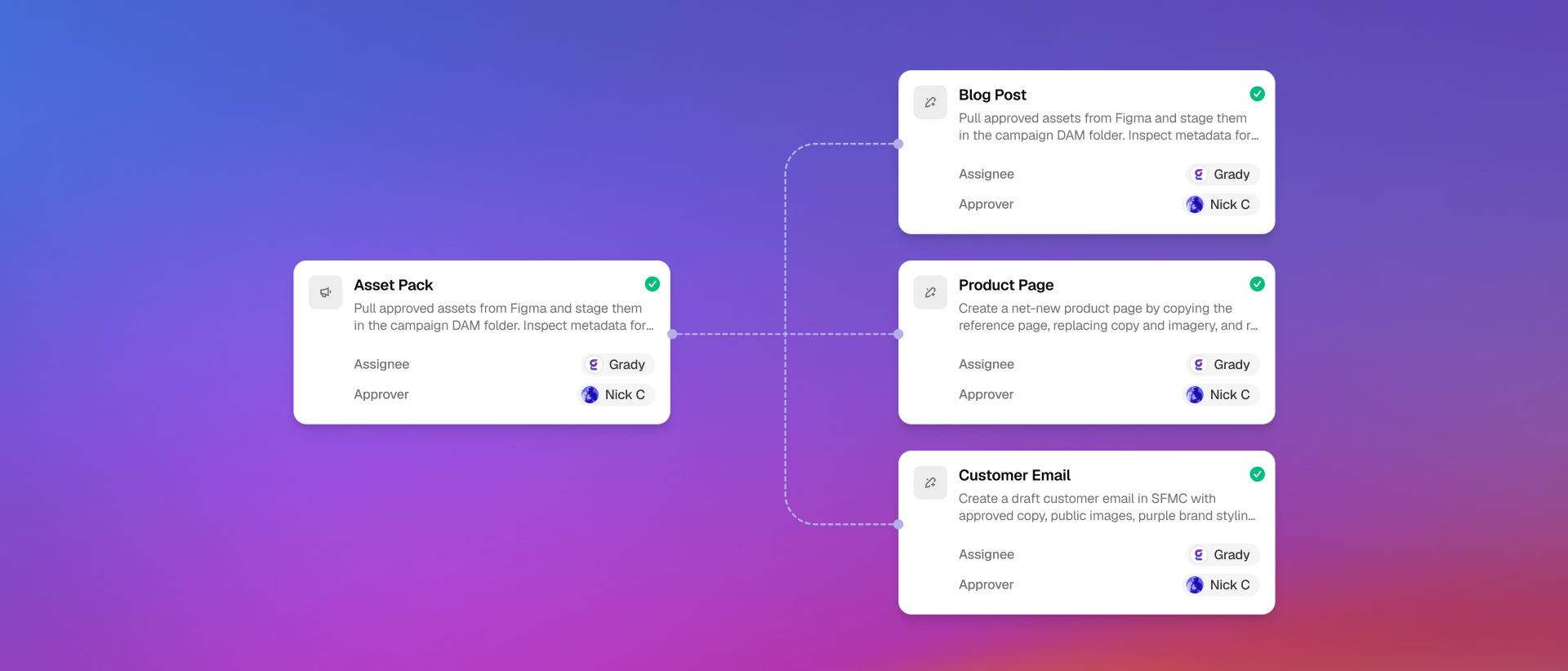
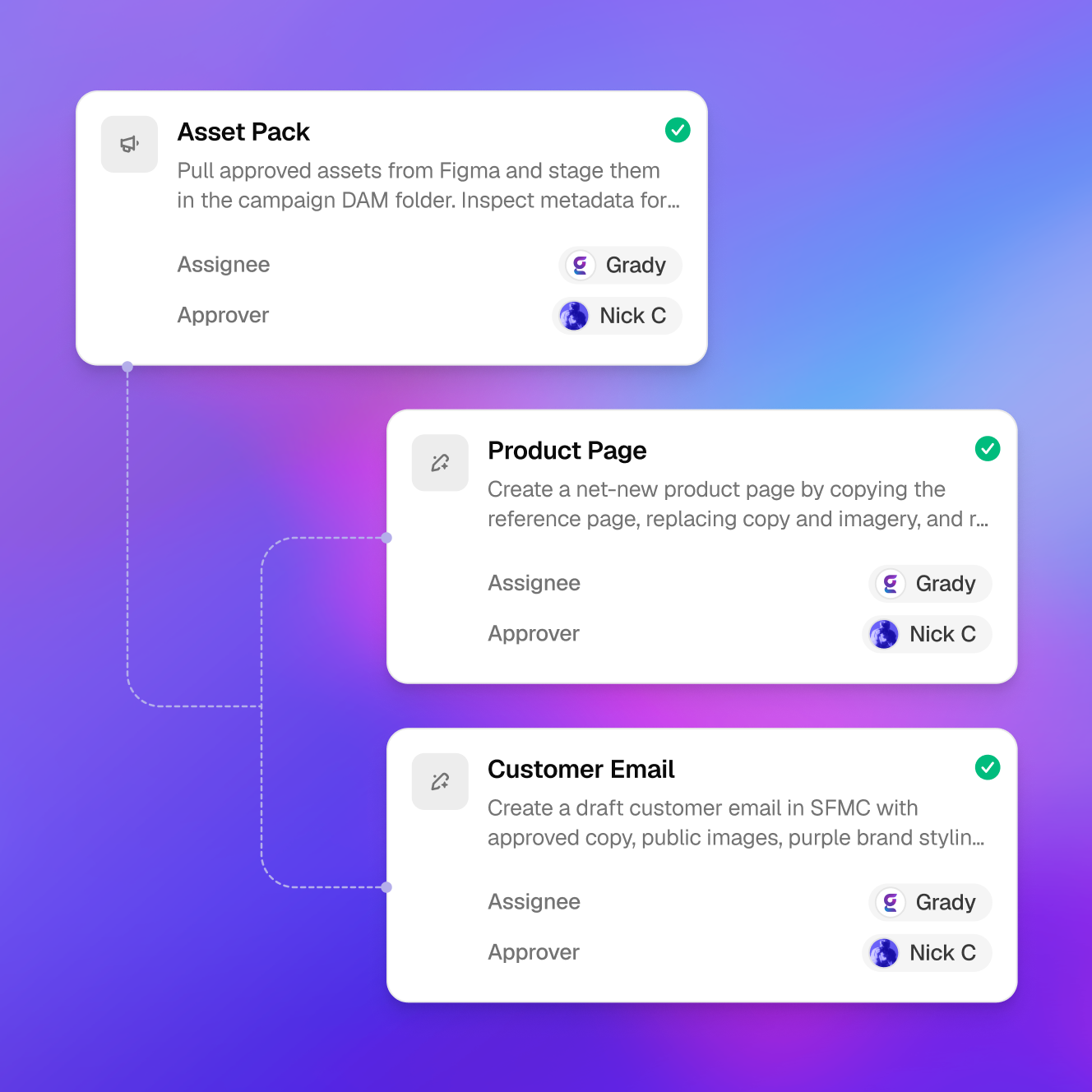
Gradial is the marketing operations system of work for enterprises. Gradial agents execute operational work across connected marketing systems while workflows carry business context, brand rules, evidence, permissions, and human decisions from request to verified result.
- Intake-triggered routing: Gradial turns briefs, tickets, designs, copy documents, and system events into scoped work with owners and dependencies.
- Reusable enterprise context: Gradial Skills preserve brand, product, content-model, workflow, governance, and review guidance for repeated use.
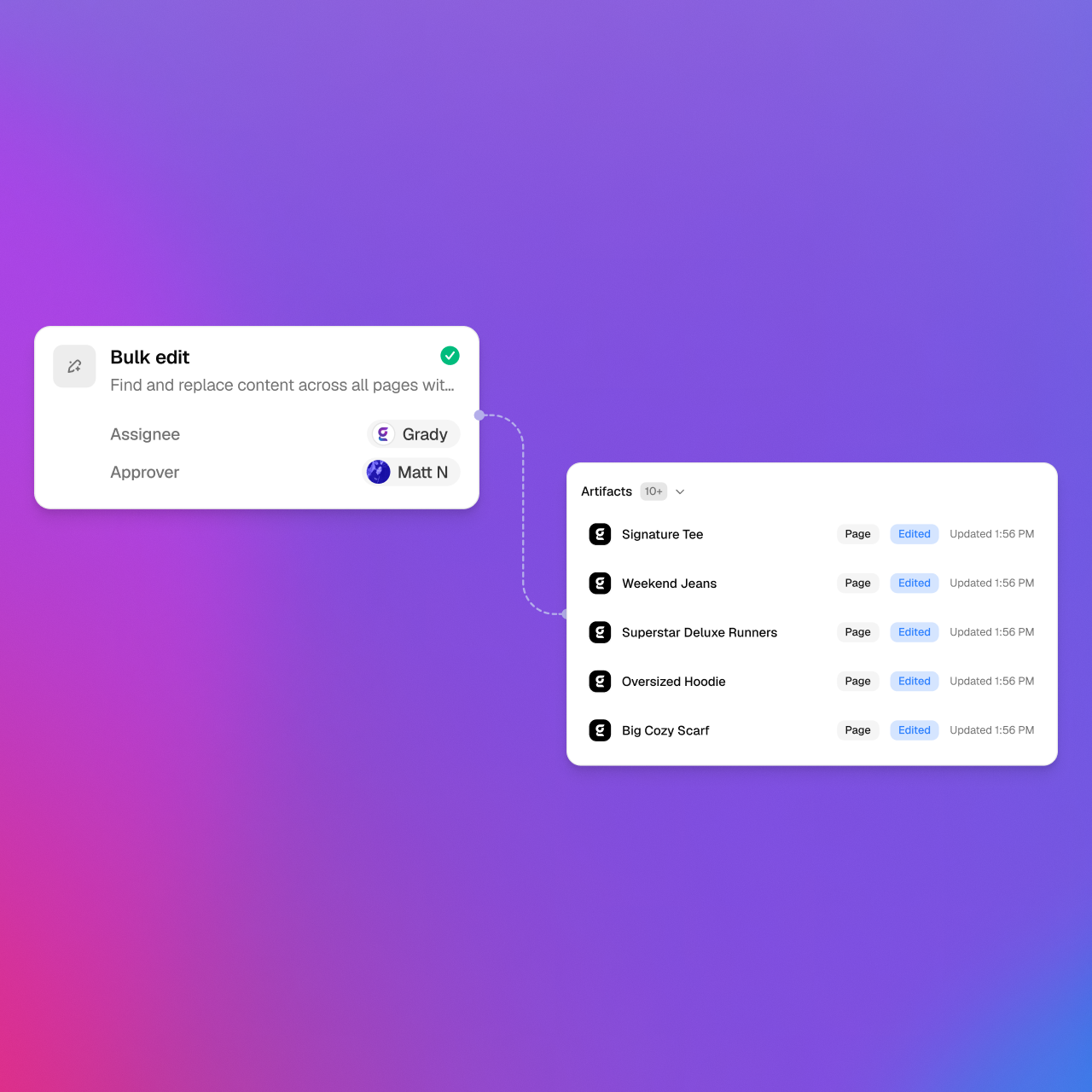
- Cross-system execution: Gradial agents can prepare and apply authorized work across connected CMS, DAM, design, analytics, collaboration, campaign, and workflow systems.
- Evidence-attached reviews: Gradial carries sources, changes, checks, previews, exceptions, and requested decisions into approval.
- Bounded release control: Drafting, approval, release selection, and publication remain separate actions with explicit authority.
- Visible verification: Gradial checks the changed resource and the rendered experience before treating customer-visible work as complete.
A 90-day adoption roadmap
Days 1 to 30: Map one recurring flow
Select a high-friction outcome with a clear owner and repeatable demand. Document inputs, systems, handoffs, controls, exceptions, time, quality, and cost. Establish the baseline.
Days 31 to 60: Standardize and connect
Create a required intake contract, approved context package, reusable modules, DAM rules, review evidence, and destination-system permissions. Automate deterministic checks and draft preparation.
Days 61 to 90: Run and learn
Execute the complete workflow with human approval at consequential points. Measure first-pass approval, rework, cycle time, exceptions, cost, and audience outcome. Expand only the controls that proved reliable.
Frequently asked questions
What is content supply chain automation?
Content supply chain automation coordinates intake, reusable content, assets, localization, approvals, release, governance, and measurement through connected workflows. It carries approved context and evidence across systems so work can advance without repeated manual coordination.
How is content supply chain automation different from content operations?
Content operations is the broader discipline for planning, producing, governing, distributing, and improving content. Content supply chain automation is the implementation pattern that connects lifecycle steps, systems, controls, and evidence to reduce manual handoffs.
What role does a DAM play?
The DAM controls asset identity, rights, metadata, renditions, relationships, approvals, and reuse. A supply chain workflow uses those controls to select and place the correct asset without losing authority or lineage.
Does automation remove human approval?
No. Automation prepares work, applies stable rules, gathers evidence, and routes decisions. Humans remain accountable for consequential brand, legal, creative, market, risk, and live-release decisions according to policy.
How should enterprises measure the content supply chain?
Measure audience outcome, content quality, cycle time, backlog, handoffs, review time, rework, cost per approved outcome, exceptions, and audit completeness. Compare the same unit of work before and after the operating change.
Where should a team start?
Choose one recurring outcome with visible friction, stable demand, accessible systems, and an accountable owner. Standardize intake and evidence before adding more automation.
What a governed content supply chain produces
- Complete requests with approved sources, owners, risk, destinations, and definitions of done.
- Reusable content and assets with lineage, rights, metadata, and update rules.
- Market-ready variants that preserve meaning, structure, compliance, and local accountability.
- Evidence-based approvals and bounded release decisions.
- A measurement loop that improves quality, capacity, cost, and audience outcomes.
- Standardize intake first: Turn requests into executable work.
- Assess your operating maturity: Compare the workflow against the five-stage content operations model.
- Map a content supply chain with Gradial: Choose one high-friction flow and connect it to governed execution.