
AI Summary
- A marketing agent can plan and perform multistep tasks. A marketing system of work coordinates agents, people, tools, context, approvals, and governance across the organization.
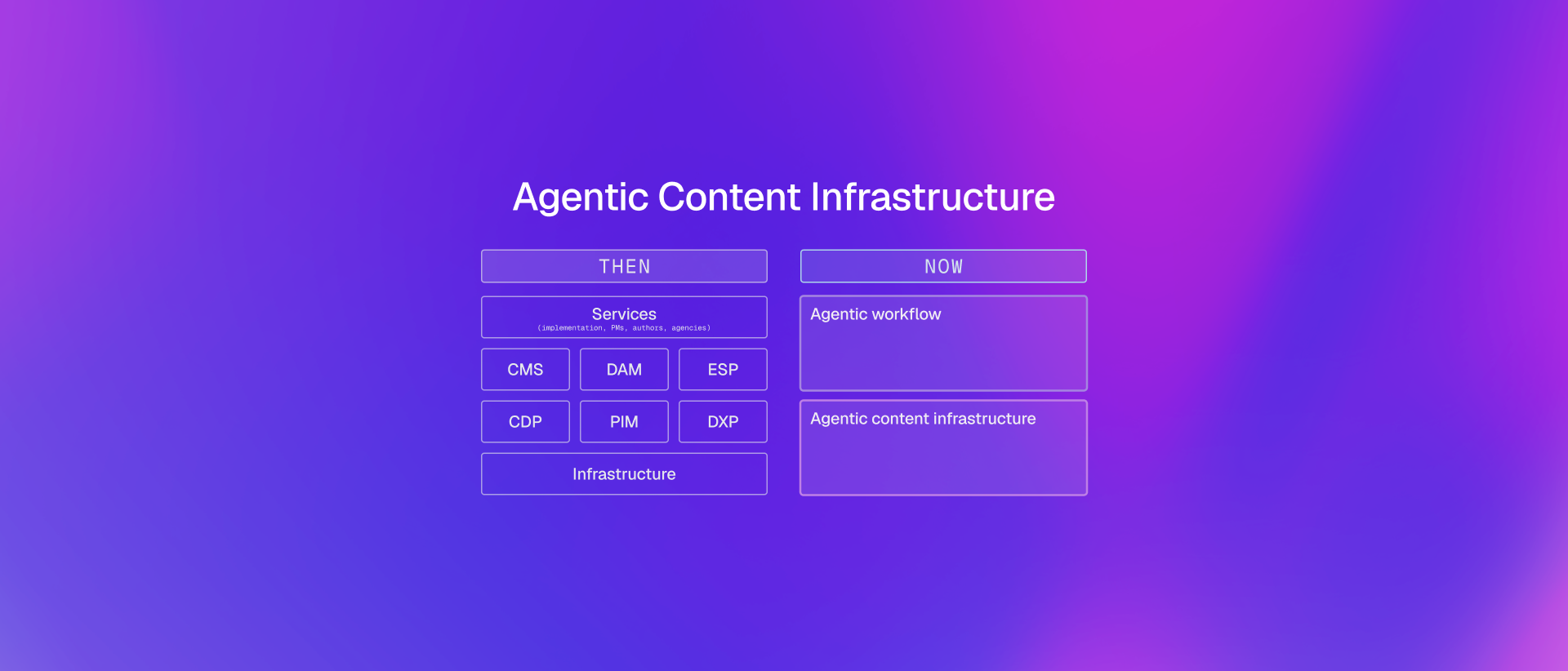
- Systems of record store the official objects of marketing. A system of work moves those objects through the operating process required to get work live.
- An agent is an execution participant. A system of work is the shared environment that makes agentic execution repeatable, reviewable, and useful across generalized marketing use cases.
- Gradial is the system of work for enterprise marketing, connecting the existing stack so agents and people can execute together without replacing core systems.
Marketing agents can do far more than answer a prompt. They can plan and perform multistep tasks, use tools, and carry work toward a defined goal. But an agent alone is not an operating model for enterprise marketing.
Enterprise work moves through shared systems, teams, rules, approvals, and decisions. A page update may involve a ticket, a copy document, a design, approved assets, a CMS build, brand and accessibility checks, legal review, and a final human approval. The agent can execute steps in that process. The system of work provides the environment that keeps the entire process connected and governed.
That is the difference between an agent and a system of work.
Short answer: A marketing agent performs multistep work. A marketing system of work coordinates agents, people, tools, organizational context, workflows, approvals, and evidence of what happened—across many marketing use cases.
What is a marketing agent?
A marketing agent is software that can pursue a goal, plan a sequence of steps, use connected tools, and take action with an appropriate level of human direction. Unlike a basic conversational interface, an agent can move beyond producing an answer and perform work.
For example, an agent might read a brief, assemble a page in a CMS, update asset metadata, run a quality check, or prepare campaign variants. A more capable agent can complete a multistep task, respond to results, and ask for input when a decision requires human judgment.
That makes agents powerful execution participants. But the agent still needs an operating environment: access to approved business context, a defined workflow, permissions, review gates, other people and agents, connected tools, and a record of the work. Without that surrounding system, every team has to rebuild the harness around the agent for every use case.
What is a marketing system of work?
A marketing system of work is the shared operating environment where people and agents plan, execute, review, approve, and improve marketing across the systems where work already happens.
It provides the harness around agentic execution: organizational context, workflow orchestration, connected tools, permissions, multiplayer collaboration, approval gates, governance, artifacts, and traceability. It can coordinate one agent, several specialized agents, human contributors, and external systems as one governed sequence of work.
A system of work is also broader than a single use case. The same operating model can support page creation, content updates, campaign production, email builds, asset operations, localization, quality assurance, bulk changes, AI search optimization, and other recurring work without designing a new process from scratch each time.
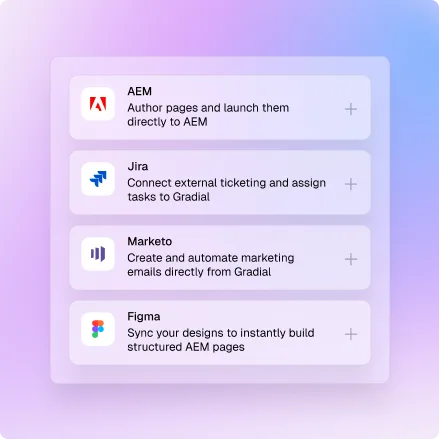
For Gradial, the objective is not to replace the CMS, DAM, ticketing platform, design tool, email platform, or analytics system. Those remain valuable systems of record. Gradial connects and operates across them so work can move from approved direction to live execution with people in control.
The practical difference: task execution versus organizational execution
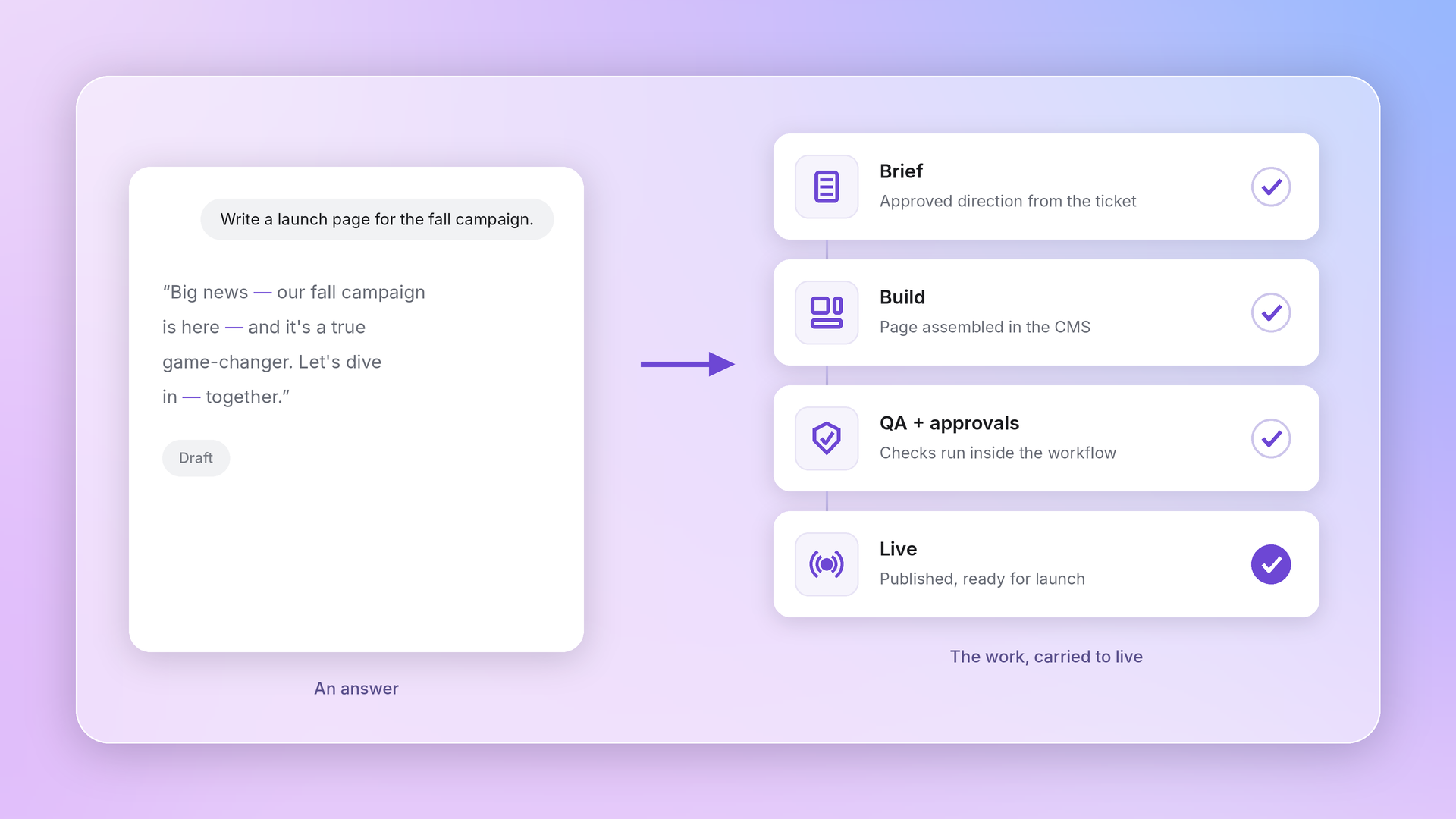
An agent can deliver an execution result: a page assembled, a set of assets tagged, a document analyzed, or a quality check completed. A system of work turns those results into a repeatable organizational outcome by coordinating the full path across agents, people, tools, rules, and approvals.
The distinction is not that agents only answer while platforms act. Agents act. The distinction is the scope of the operating model around that action.
- Primary role: an agent performs work toward a goal; a system of work coordinates how work moves across the organization.
- Workflow: an agent can follow and complete steps; a system of work manages sequencing, dependencies, parallel work, handoffs, and review gates across participants.
- Participants: an agent is one participant; a system of work lets people, multiple agents, and tools work together.
- Context: an agent uses the context available to it; a system of work stores, builds, and applies shared business, brand, content, workflow, and governance context.
- Control: an agent operates within permissions; a system of work defines scopes, approvals, escalation paths, and evidence across the workflow.
- Reuse: an agent may solve one task well; a system of work provides a generalized foundation for many repeatable marketing use cases.
Where a marketing agent is the right choice
A marketing agent is a strong fit when a goal and execution boundary are clear. Examples include:
- Researching a market and turning the findings into a structured brief.
- Building a page from approved copy and design inputs.
- Updating asset metadata according to a defined taxonomy.
- Generating and checking campaign variants against established rules.
- Running a content or quality review and preparing recommended changes.
- Completing a multistep update within one connected workflow and permission scope.
These are real execution jobs, not simply drafting exercises. The agent is the right unit when one bounded goal can be completed with available context, tools, and controls.
Where an agent alone begins to break down
The work involves many participants
Enterprise marketing is multiplayer. A single workflow may involve a requester, marketer, designer, content owner, legal reviewer, regional lead, several specialized agents, and the systems each person owns. The work needs shared state and clear handoffs, not only an agent with a long task list.
Context must persist across use cases
Every new task should not require teams to reconstruct brand standards, component rules, content models, naming conventions, market differences, approval paths, and legal guidance. A system of work makes that context reusable and applies it where the work happens.
Approvals and governance must shape execution
Enterprise control is not one final yes-or-no prompt. Teams need to decide which steps agents can complete independently, which require review, who can approve a change, and what happens when a rule or exception is triggered.
The organization needs a durable operating record
Teams need to know what changed, where it changed, which agent or person acted, which checks ran, who approved the result, and what remains before launch. That evidence belongs to the workflow, not to one agent conversation.
The operating model must generalize
A custom agent setup can solve one use case. Enterprise leverage comes from reusing the same context, controls, integrations, and collaboration model across pages, campaigns, email, assets, localization, quality, search, and other operational work.
Seven capabilities to evaluate
When evaluating a marketing agent or a broader system of work, look beyond a successful task demo. Ask what will make execution reliable across the organization.
- Multistep execution. Can an agent plan, perform, and adapt a sequence of actions toward a clear goal?
- Execution in end systems. Can it carry out controlled work in the CMS, DAM, ticketing platform, design system, email platform, or other system—not merely describe the steps?
- Workflow orchestration. Can it manage dependencies, parallel work, review gates, exceptions, and handoffs among people, agents, and tools?
- Persistent organizational context. Can it repeatedly apply approved brand, content, workflow, governance, and business context?
- Multiplayer control and approvals. Can teams define who directs, reviews, approves, or takes over each part of the work?
- Traceable artifacts and governance. Does it preserve deliverables, changes, quality findings, decisions, and approval records as part of execution?
- Generalized use cases. Can the organization reuse the same operating foundation across workflows, channels, systems, and markets rather than building a new harness for every agent?
A simple decision framework
Use a marketing agent when:
- The goal and execution boundary are clear.
- The agent has the context, permissions, and tools needed for the task.
- One agent can complete the work or return a defined result.
- Human review can happen at a simple, known checkpoint.
- The use case does not require a broader organizational workflow.
Use a marketing system of work when:
- The work crosses several systems, teams, or specialized agents.
- Context and rules must persist across tasks and use cases.
- Dependencies, parallel work, exceptions, or handoffs must be coordinated.
- Different people need to direct, review, and approve parts of the work.
- The organization needs traceability, reusable artifacts, and governed execution at scale.
- The operating foundation must support many workflows rather than one agent task.
The choice is not either-or. Agents perform the work inside a system of work. The system gives those agents the context, coordination, controls, and human collaboration required to become part of how the marketing organization operates.
How Gradial becomes the system of work for marketing
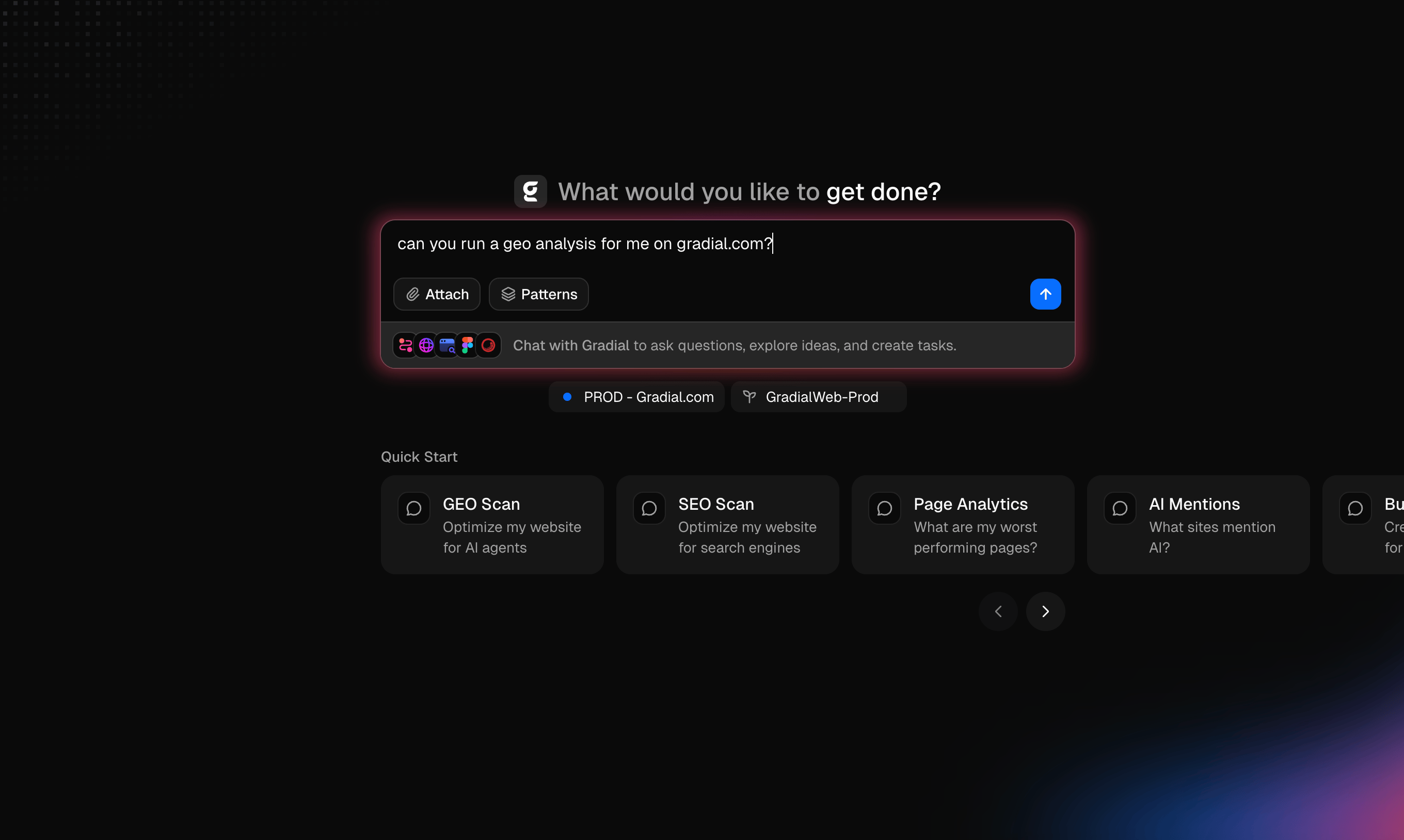
Gradial is the system of work for enterprise marketing. It connects the systems enterprises already use, builds and applies organizational context, orchestrates agent and human steps, and keeps governance inside the workflow.
Agents execute the operational work between brief and live. Gradial provides the harness around them: shared context, workflow, connected tools, collaboration, approvals, quality controls, artifacts, and a traceable record of execution. That makes the same foundation useful across content, campaigns, assets, email, localization, quality assurance, AI search visibility, and other marketing operations.
The approach is additive. The CMS remains the content system of record. The DAM remains the asset system of record. The ticketing platform remains the request system of record. Gradial works across them so people and agents can move work forward without relying on manual transfers at every seam.
Public customer examples show why the operating model matters. AWS reports that page creation moved from roughly ten hours per page to about thirty minutes per page with Gradial. Avalara reports a path from Jira ticket to publish-ready page moving from about 4.5 days to under one day, with template rules, approvals, and workflow write-back built into the motion.
These are not simply faster agent tasks. They are examples of the system around the work changing how marketing reaches completion.
The category question is not “Which agent is smarter?”
Agent capability matters, but it is not the full enterprise decision. The harder problem is turning agentic execution into a reliable operating model across tools, teams, use cases, and policies.
A capable agent can complete a multistep marketing task. A system of work can decide where that task belongs, supply the right context, coordinate other agents and people, route approvals, preserve evidence, and carry the result into the next step. One is an executor. The other is how the organization executes.
Do you need an agent to complete a task, or a system where agents and people can get marketing work all the way to market?
Frequently asked questions
What is a system of record for marketing?
A marketing system of record stores an authoritative object or dataset. A CMS stores content, a DAM stores assets, a CDP stores customer data, and a ticketing platform stores requests and status. Each remains essential, but each usually represents one part of the operating environment.
How is a marketing system of work different from a system of record?
A system of record holds the official information. A system of work coordinates what people and agents do with that information across systems. It applies context, runs workflows, connects tools, manages approvals, and preserves evidence as work moves toward completion.
What is an agent for marketing?
A marketing agent is software that can pursue a defined goal, plan and complete multiple steps, use tools, and take action within a permission scope. Marketing agents can perform work such as page assembly, content updates, asset operations, campaign production, analysis, or quality checks.
Does a system of work replace marketing agents or the martech stack?
No. Agents execute within the system of work, while existing systems continue to hold content, assets, data, tickets, and campaign configurations. The value comes from coordinating people, agents, and tools across that stack.
What should enterprise teams pilot first?
Start with a workflow that is repetitive, measurable, and operationally constrained: page creation, a governed content update, asset metadata work, a recurring campaign build, or a controlled bulk change. Measure elapsed time, manual handoffs, review effort, quality findings, and rework—not only whether an agent can complete the first task.
See a system of work in your marketing stack
If marketing execution is still held together by queues, copy-and-paste, custom agent setups, and status chasing, the next step is not simply another agent. It is a shared system where agents, people, and tools can move governed work from brief to live.
Get updates from where the work gets done
Sign up to receive product releases, execution insights, and real-world use cases from the Gradial system of work.